

Over the last decade, Colombia has experienced changes in monetary poverty, with a rapid decline during the recovery in the post-2020 period. This paper investigates the factors that drove these recent changes and asks whether the mechanisms that drove poverty reduction after 2020 differ from those observed in previous periods. Our main contribution is a detailed income-based decomposition that identifies the role of labor income (formal and informal), non-labor income, institutional transfers, demographic factors, and economic sectors in reshaping poverty dynamics. We show that while poverty reduction before the pandemic (2012-2019) was mainly due to demographic changes and increased formal employment, the accelerated decline observed between 2021 and 2024 is largely explained by the recovery of labor markets, despite the reduction in government transfers. These aggregate trends mask territorial heterogeneity: recent progress is concentrated in major urban areas, while several Caribbean cities lag behind, and rural poverty reduction depends to a greater extent on agriculture and non-labor sources of income. In addition, we observe that the decline in aggregate monetary poverty prior to the 2020 economic shock was largely due to rural centers and secondary cities.
The most recent
Approach
This paper investigates the factors driving changes in monetary poverty in Colombia over the past decade, with particular attention to the sharp decline observed during the post2020 recovery period. To do so, it applies a statistical methodology that decomposes household income into different sources. This approach makes it possible to identify what contributed most to households’ economic wellbeing: labor income (both formal and informal), government transfers, pensions, and demographic shifts. The analysis goes beyond the national average and examines differences across major cities, rural areas, and regions of the country to better understand the local dynamics behind the evolution of poverty.
Contribution
It is essential to determine whether the recent reduction in poverty stems from the same forces that operated in the past or whether it reflects a new economic dynamic. The main contribution of this study is to show that the postpandemic recovery differs markedly from the patterns observed during the preceding decade. The findings reveal that national growth masks highly unequal realities. While some areas have progressed rapidly, others have stagnated, highlighting that a single public policy strategy is not suitable for all regions.
Moreover, the study provides a stepbystep decomposition of income, distinguishing between formal and informal sources and breaking the analysis down by economic sectors. This allows us not only to determine whether poverty has declined, but also to understand why, where, and which sectors or labormarket dynamics played the largest role.
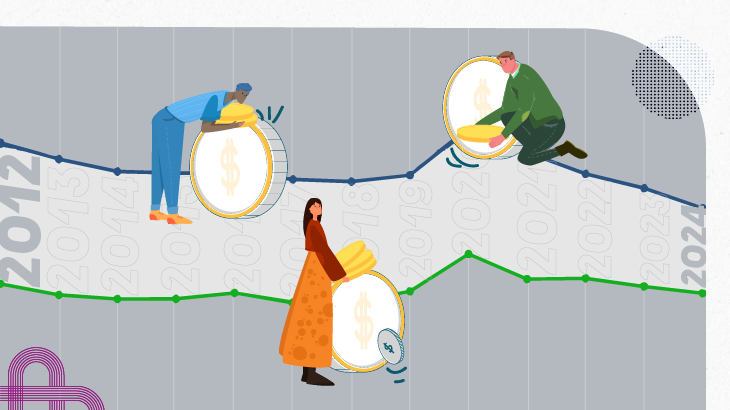
The story of poverty reduction in Colombia has two very different chapters. Between 2012 and 2019, poverty declined mainly due to demographic changes and the expansion of formal employment. However, the accelerated drop between 2021 and 2024 was driven primarily by the strong recovery of the labor market.
Results
The study shows that the story of poverty reduction in Colombia has two very different chapters. Between 2012 and 2019, poverty decreased mainly due to demographic changes and the expansion of formal employment. However, the accelerated decline between 2021 and 2024 was driven primarily by the strong recovery of the labor market. Households were able to exit poverty thanks to access to new jobs, which offset the reduction in government assistance after the health emergency. In fact, if poverty depended solely on current subsidies, it would have increased.
These improvements were not uniform across the country. Large cities led the national reduction in poverty, while several capitals in the Caribbean region showed limited progress. In rural areas, the decline in poverty was less associated with formal employment and more closely linked to agriculture, informality, and nonlabor income.