
Nowcasting economic activity with electronic payments data: A predictive modeling approach

Borradores de Economia
Number: 
1037
Published: 
Classification JEL: 
E27, C53, C45

The most recent

María Teresa Ramírez-Giraldo, Karina Acosta, Olga Lucia Acosta Navarro, Lucia Arango-Lozano, Fernando Arias-Rodríguez, Oscar Iván Ávila-Montealegre, Oscar Reinaldo Becerra Camargo, Leonardo Bonilla-Mejía, Grey Yuliet Ceballos-Garcia, Luz Adriana Flórez, Juan Miguel Gallego-Acevedo, Luis Armando Galvis-Aponte, Luis M. García-Pulgarín, Andrés Felipe García-Suaza, Anderson Grajales, Daniela Gualtero-Briceño, Didier Hermida-Giraldo, Ana María Iregui-Bohórquez, Juliana Jaramillo-Echeverri, Karen Laguna-Ballesteros, Francisco Javier Lasso-Valderrama, Daniel Márquez, Carlos Alberto Medina-Durango, Ligia Alba Melo-Becerra, María Fernanda Meneses-González, Juan José Ospina-Tejeiro, Andrea Sofía Otero-Cortés, Daniel Parra-Amado, Juana Piñeros-Ruiz, Christian Manuel Posso-Suárez, Natalia Ramírez-Bustamante, Mario Andrés Ramos-Veloza, Jorge Leonardo Rodríguez-Arenas, Alejandro Sarasti-Sierra, Bibiana Taboada-Arango, Ana María Tribín-Uribe, Juanita Villaveces
Carlos David Ardila-Dueñas, Joel Santiago Castellanos-Caballero, Carlos David Murcia-Bustos
Wilmer Martinez-Rivera, Manuel Darío Hernández-Bejarano

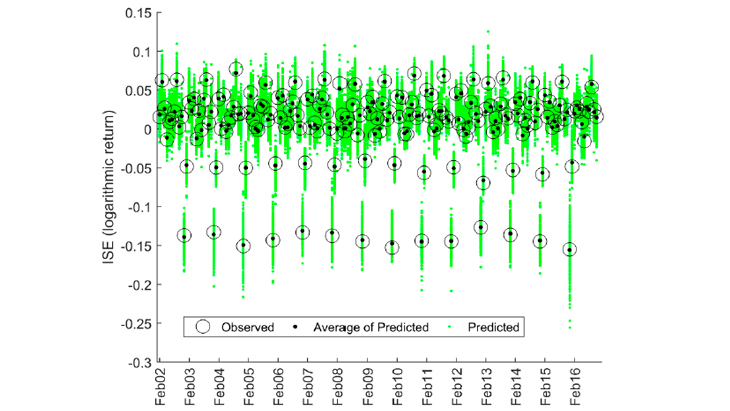
Economic activity nowcasting (i.e. making current-period estimates) is convenient because most traditional measures of economic activity come with substantial lags. We aim at nowcasting ISE, a short-term economic activity indicator in Colombia. Inputs are ISE’s lags and a dataset of payments made with electronic transfers and cheques among individuals, firms, and the central government. Under a predictive modeling approach, we employ a nonlinear autoregressive exogenous neural network model. Results suggest that our choice of inputs and predictive method enable us to nowcast economic activity with fair accuracy.

Also, we validate that electronic payments data significantly reduces the nowcast error of a benchmark non-linear autoregressive neural network model.

Nowcasting economic activity from electronic payment instruments data not only contributes to agents’ decision making and economic modeling, but also supports new research paths on how to use retail payments data for appending current models.