
Connectivity disruptions in transport infrastructure quickly pass through to the formation of food prices. This paper quantifies the effect of closures on the Bogotá–Villavicencio Road, a corridor that links the Orinoquía region with the country’s main consumption centers, on food prices in Colombia. A panel dataset is constructed from the Agricultural Sector Price and Supply Information System (SIPSA, in Spanish) of DANE, linked to records from the National Institute of Roads (INVIAS, in Spanish) on closure episodes for the 2014–2024 period. Using panel estimations with product and market fixed effects and time controls, the study documents statistically significant price increases during closures, consistent with higher logistics costs and supply constraints. The results indicate that disruptions in strategic corridors have an immediate impact on consumer welfare and support the need for risk‑management strategies and the strengthening of road‑infrastructure resilience.
The most recent
Approach
This paper examines the link between road infrastructure and food price stability in Colombia by analyzing closures on the Bogotá–Villavicencio road. This corridor plays a strategic role in connecting the Orinoquía region with the country’s main urban centers and is essential for the supply of fresh food products, particularly to Bogotá, which acts as a central node in the national distribution system.
In this context, frequent road closures due to landslides, material falls, and extreme weather events constitute exogenous connectivity shocks that disrupt logistical flows, increase transportation costs, and generate temporary tensions in food supply. The study focuses on identifying how these disruptions are transmitted to wholesale prices observed in the country’s food supply hubs, where key price signals for the rest of the food supply chain are formed.
Contribution
The paper’s main contribution is to provide empirical evidence on the economic effects of road closures along a critical corridor, integrating detailed information on prices and supply with administrative records of infrastructure disruptions. To this end, the study constructs a monthly database for the period 2014–2024, combining price and supply records from Sipsa of the National Administrative Department of Statistics (DANE in Spanish) with reports on road closures from Invías.
An econometric strategy is employed that controls for structural differences across products, markets, and regions, as well as for common time effects. This approach allows the analysis to isolate the variation specifically associated with road closures and to advance toward a causal measurement of their impact on prices. In doing so, the paper contributes to the literature on infrastructure and food markets by incorporating a territorial and operational perspective, which has been relatively unexplored in the Colombian case, and by highlighting the role of road reliability, beyond the mere existence of infrastructure, as a key determinant of price stability.
In Bogotá and the Eastern region, road closures lead to price increases close to 2%, reflecting a high degree of functional dependence on this corridor. In contrast, other regions show more moderate or non-significant effects, suggesting greater diversification of routes, sources, and supply circuits.
Results
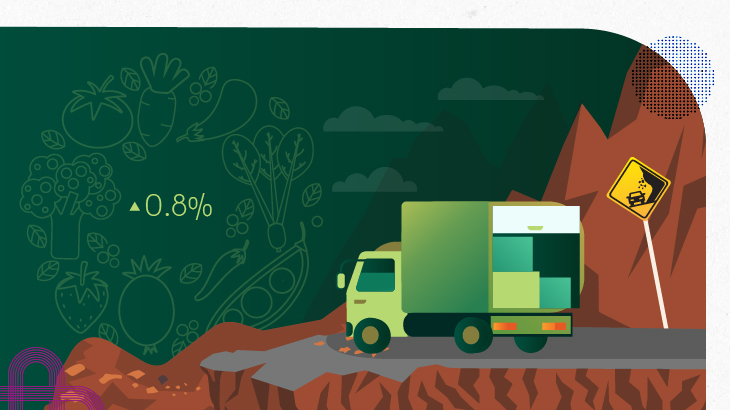
The results indicate that closures on the Bogotá–Villavicencio road are associated with statistically significant increases in wholesale food prices observed in the country’s supply hubs. On average, at the national level, prices increase by around 0.8% during months with road closures, suggesting that the logistical frictions derived from the loss of connectivity are partially passed through to markets.
However, the impact displays marked regional heterogeneity. In Bogotá and the Eastern region, road closures translate into price increases close to 2%, reflecting a high degree of functional dependence on this corridor, both due to geographic proximity and its role in the redistribution of national food supply. In contrast, other regions exhibit more moderate or statistically insignificant effects, suggesting a greater diversification of routes, sources, and supply circuits.
Overall, the evidence shows that Colombia’s food supply system has some capacity to adjust to connectivity shocks, but this resilience is incomplete and uneven, revealing territorial vulnerabilities with relevant implications for infrastructure policy, risk management, and food security.