

 Andrés Felipe García-Suazae,
Disadvantaged communities worldwide have been the focus of government-sponsored programs aimed at improving living standards and fostering economic development. Decentralization has emerged as a central strategy in this effort, strengthening accountability, and promoting local development, a trend to which Colombia is no exception. This paper examines the effects of a regionally targeted transfer program that designated additional resources to municipalities allocated along the Magdalena River, the longest country’s waterway. To identify causal impacts, we exploit the 2002 reform that significantly reduced these transfers and apply a difference-in-differences approach using panel data for the period 1994-2019. The findings reveal no effects on social outcomes but a slowdown in economic activity, accompanied by reductions in municipal operating expenditures and investment, while revealing an increase in tax revenues. These results highlight the complex interplay between fiscal decentralization and regional development, raising important questions about the effectiveness of targeted transfers in achieving their intended objectives.
The most recent
Approach
The transfer of political, administrative, and fiscal responsibilities from national governments to subnational entities has been analyzed for decades in numerous countries with diverse characteristics and political ideologies. Decentralization emerged as a response to the need to improve governance and as a potential remedy for the deprivation experienced by local communities in accessing essential public goods and services—particularly in health, education, and basic sanitation (Besley and Coate, 2003; Faguet, 2004; Bergvall et al., 2006; Del Valle and Galindo, 2010; Brosio and Jimenez, 2012). Another key motivation behind the rise of decentralization, closely linked to the previous point, has been the growing pattern of regional disparities (Brosio and Jimenez, 2012; Panzera and Postiglione, 2021; Marchand et al., 2020; McCann, 2020; Pike et al., 2010). The presence and persistence of such imbalances explain why many economies have opted to implement policies aimed at improving living standards in lagging regions (Bonet et al., 2023).
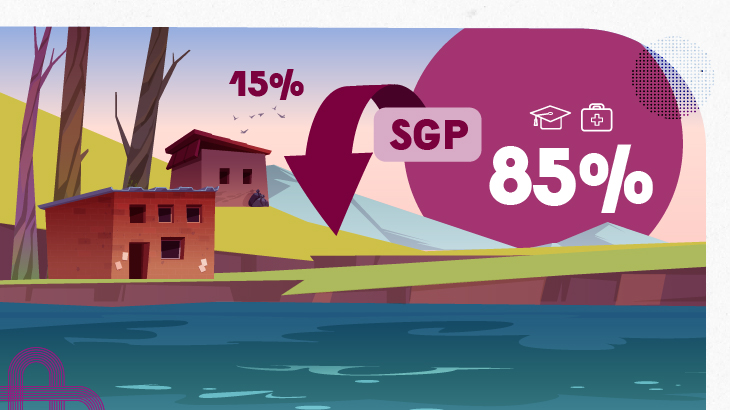
In Colombia, the 1991 Constitution sought to deepen decentralization by assigning new responsibilities to departments and municipalities, accompanied by additional and increasing financial resources (Bonet et al., 2020). However, the economic crisis of the late 1990s— which reduced tax revenues and threatened the sustainability of education and health coverage—prompted a reform that introduced a new transfer system in 2002: the Sistema General de Participaciones (SGP). This system consolidated resources into a single fund for municipalities and departments, delinking transfers from national current revenues and instead indexing them to inflation. Under this arrangement, more than 85% of the resources were allocated to education, health, and basic sanitation, while the remainder was regionally distributed based on specific criteria: population size (municipalities with fewer than 50,000 inhabitants), Indigenous reserves, and municipalities located along the Magdalena River (Bonet et al., 2016). Despite the time elapsed since the introduction of these transfer schemes, only the first criterion has undergone a formal evaluation in Colombia.
Contribution
This study contributes to the analysis of the effects of regionally targeted transfers to municipalities located along the Magdalena River. Specifically, it seeks to assess the extent to which these transfers influenced socioeconomic indicators, as well as local development and population well-being.
The findings underscore the vulnerability of riverside municipalities to fiscal shocks and their dependence on intergovernmental transfers to sustain development.
Results
The results indicate a deterioration in local economic activity and a decline in municipal investment following the 2002 reform that reduced transfers. These findings underscore the vulnerability of riverside municipalities to fiscal shocks and their dependence on intergovernmental transfers to sustain development. At the same time, the increase in tax revenues observed during this period reveals a certain degree of resilience and adaptive capacity among local governments, which sought to compensate for the loss of resources through higher tax collection.
The analysis also shows that the 2007 legislation requiring special transfers to be earmarked for environmental and navigability-related projects did not translate into effective implementation. This reflects weaknesses in governance and enforcement mechanisms, as well as competing priorities that diverted resources away from their originally intended purposes.